
Outsourced Product Development: How to Do It Right

Outsourced product development means handing a defined part of building a product, or the whole thing, to an outside team that is accountable for the result. It works best when one senior team covers strategy, design, engineering and data together, so ideas don’t get lost between vendors. That is how we build at Inner Roots: one studio, one team, and first releases typically within two weeks.
This guide is for founders and business leaders who need to ship and don’t want to spend six months hiring first. It covers what you can outsource, the models on offer, what drives cost, and how to pick and manage a partner.
TL;DR
- Outsourced product development puts strategy, design, engineering and data in the hands of an external team, so you can ship without building every function in-house first.
- The biggest risk is the handoff between separate vendors (strategy to design to code), not the outsourcing itself. One integrated team removes most of those handoffs.
- Cost is driven by seniority, scope clarity and engagement model far more than by hourly rate alone.
- Judge a partner on who actually does the work, how fast a real release appears, and what you own and can run when they leave.
- Our studio delivers first releases within two weeks and designs enablement to outlast the engagement.
Table of Contents
- What outsourced product development covers
- Outsourced versus in-house: what the evidence says
- Engagement models and how they differ
- Why one integrated team beats a chain of vendors
- The process, from discovery to launch
- What drives the cost
- How to evaluate a partner
- What to prepare before you start
- Beyond the build
- Work with a team that carries ideas through
- FAQ
- Sources
What outsourced product development covers
People use the phrase for three different things, and mixing them up leads to bad contracts.
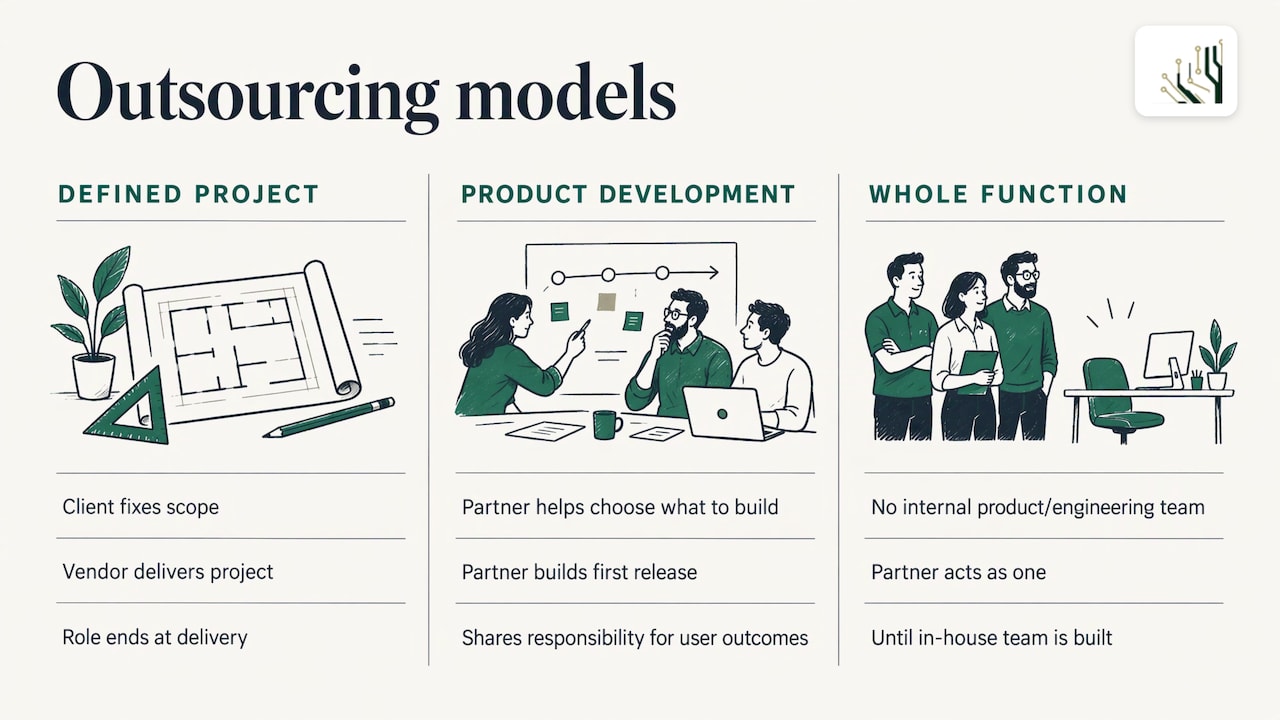
Outsourcing a defined project. You know exactly what you want, such as a marketing site or an integration, and you pay for that deliverable. Scope is fixed and the vendor’s job ends at delivery.
Outsourcing product development. The outside team helps decide what to build as well as building it. That includes discovery, roadmap, UX research, UI design, engineering, analytics instrumentation and the first release. The team shares responsibility for whether the product works for users, not just whether the code matches a spec.
Outsourcing the whole function. You have no internal product or engineering team, and the partner acts as one until you build your own.
Most founders searching this term want the second or third. It is the point where the quality of the thinking matters as much as the quality of the code.
Work an external team can take on
- Product management and strategy: discovery sprints, roadmap planning, prioritization.
- Design and research: UX research, usability testing, UI design, brand and design systems.
- Engineering: websites, platforms, CMS setup, integrations, AI and machine learning features.
- Data: instrumentation, dashboards and analytics so you can see how the product performs.
- Growth and operations: SEO, content systems, lifecycle marketing, and even org and hiring design so the team you build next is shaped correctly.
The last two matter more than they look. A product that ships without measurement or a way to reach users is a launch nobody learns from.
Outsourced versus in-house: what the evidence says
The honest comparison is not cheap versus expensive. It is speed and focus versus control over a long hiring cycle.
The International Software Benchmarking Standards Group (ISBSG), a non-profit that collects software project data, published a 2024 short paper on in-house versus outsourced application development covering 564 data points. It found the median productivity of outsourced projects was almost 2.7 hours per function point lower, meaning faster, than in-house projects. A function point is a standard unit for measuring how much functionality software delivers. The same paper notes that project type, team expertise and management practices shape results, and that no single answer fits every company.
Read that as a pointer to what to control: the expertise of the people on your project and how the work is managed. Those are the two things to look for when you choose a partner.
When outsourcing fits best
- You need a first release in weeks, and recruiting a product lead, designer and engineers would take months.
- You need several disciplines at once for a limited time, such as research, design and build.
- You want a senior view on architecture and scope before committing to a permanent team.
- You have a team but it lacks a specific skill, such as data instrumentation or AI.
Engagement models and how they differ
Partners package work in a few common ways. Knowing the shapes helps you compare proposals fairly.
| Model | How it works | Best for | Watch for |
|---|---|---|---|
| Scoped project | Fixed deliverable, defined timeline | A clear, bounded build such as a site or integration | Change requests when the scope was vague |
| Discovery sprint, then build | Short paid phase to define scope, then delivery | Early-stage products with open questions | Make sure discovery produces usable artifacts you keep |
| Ongoing support | A recurring team relationship across disciplines | Products in continuous development | Clear priorities each cycle |
| Staff augmentation | Individual contractors join your team and you manage them | Teams with strong internal product leadership | You carry all the management and handoff risk |
Our engagements are paid consulting, either scoped projects or ongoing support across product, engineering, design, data, HR and marketing. For most founders without an internal product team, a discovery sprint followed by a scoped build is the cleanest start, because the sprint turns an idea into a plan the build can follow.
Why one integrated team beats a chain of vendors
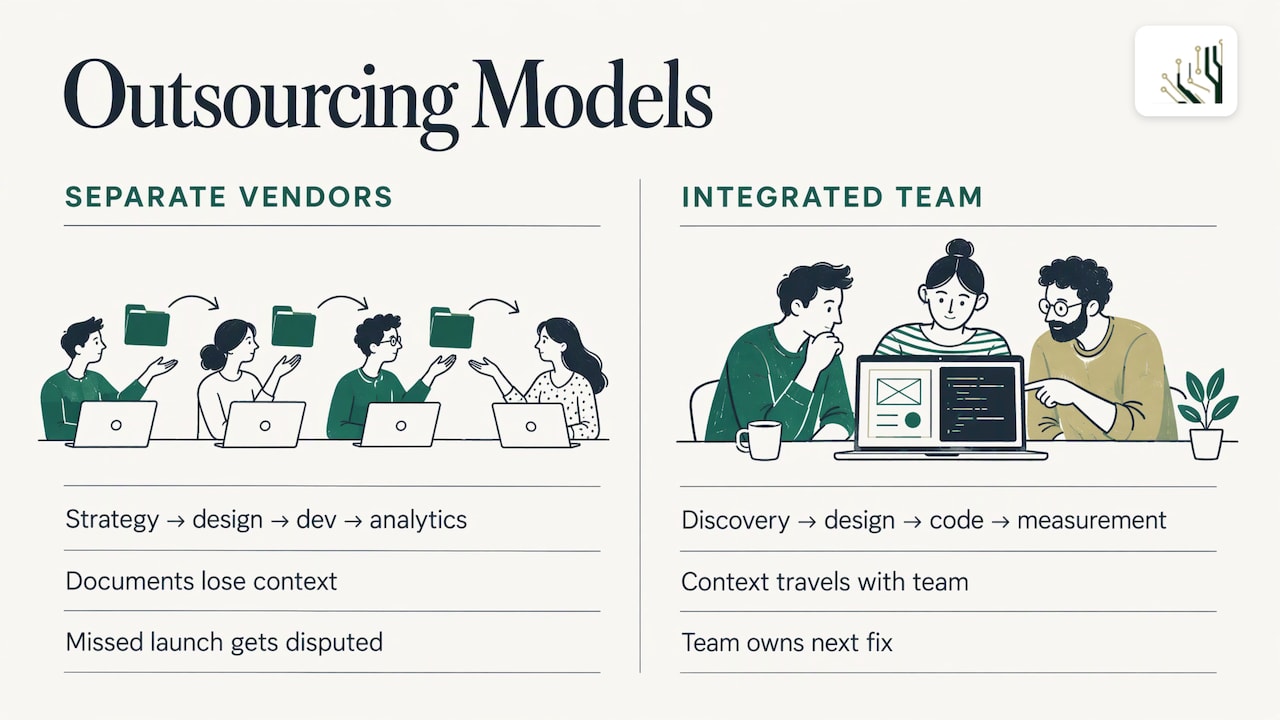
The usual way to outsource is to hire a strategy firm, then a design agency, then a development shop, then someone for analytics. Each step produces a document, and each document loses something. The reasoning behind a design decision doesn’t reach the engineer. The engineer’s constraint never reaches the strategist. By launch, the product resembles the brief less than anyone intended.
An integrated studio changes that. When the same senior people carry a product from discovery to design to code to measurement, context travels with them. That is the idea behind our model: product, engineering, design and data under one roof, so good ideas aren’t lost in transitions.
It also changes accountability. With separate vendors, a missed launch gets argued over. With one team, the question is simply what to fix next.
For a closer look at how this works on a software-as-a-service product, see our guide to SaaS product development, its process and costs.
The process, from discovery to launch
A sound outsourced engagement follows a sequence. Here it is, with where it tends to go wrong.
- Discovery. The team learns your users, constraints and goals, then defines what the first release must prove. It goes wrong when discovery is skipped and the team builds from assumptions.
- Roadmap and scoping. Work is broken into releases, with the first one small enough to ship fast. It goes wrong when scoping is optimistic. Honest scoping, including saying what won’t fit, protects your budget.
- Research and design. UX research and usability testing shape the interface before engineers commit to it. It goes wrong when design happens in isolation and arrives as a finished picture nobody can build on time.
- Build. Engineering proceeds in short cycles with working software shown regularly. It goes wrong when you see nothing until the end.
- Instrumentation. Analytics and dashboards are set up with the release, so you know what users do. It goes wrong when measurement is added later, if ever.
- Launch and learning. The release goes out, data comes back, and the roadmap adjusts.
- Handover or continuation. Either your team takes over or the partner continues. This is where enablement matters: documentation, a clean codebase and a team that understands what was built.
In our work, projects are built to ship an actual release within two weeks. A short first cycle is the best protection you have, because it surfaces problems while they are still cheap.
What drives the cost
Rates and totals differ widely, so be wary of any single price benchmark. The factors that move a quote are consistent:
- Seniority of the people doing the work. Senior-led teams cost more per hour and often less per outcome, because they make fewer wrong turns and need less rework.
- Scope clarity. Vague scope gets padded in quotes and produces change orders later.
- Breadth of disciplines. Design, engineering, data and marketing all in one engagement cost more than engineering alone, but you avoid paying several vendors to re-learn your product.
- Engagement model. Fixed scopes give predictability, ongoing support gives flexibility.
- Speed. Compressing a timeline takes more people at once.
- Location of the team. Hourly rates vary by region, but time-zone gaps and communication overhead come with that variation.
We don’t publish fixed prices because scope decides the number. We scope each engagement with you, so the quote reflects the work and not a template.
How to compare quotes
Don’t compare hourly rates alone. Ask each proposal to show the first release in concrete terms: what it contains, when it ships, and who builds it. Two quotes at the same total can hide very different amounts of senior time.
How to evaluate a partner
Six questions separate a good partner from a good pitch.
1. Who does the work? Find out whether the senior people you meet are the ones on your project. Senior-led delivery is the point of hiring a studio.
2. How fast does a real release appear? Ask for the timeline to the first working release, not to a final product. Two weeks to a first release is the pace we hold ourselves to.
3. Do they cover the full chain? A partner who handles strategy, design, engineering and data removes handoffs you would otherwise manage yourself.
4. Have they done this for companies like yours? Look at case work. Our site features Venroy, Weedmaps, Lucid Green, Valcom and Simply Malinda.
5. Is the scoping honest? A partner who tells you what to cut from the first release is protecting your money.
6. What do you keep? You should leave with working software, documentation and a team able to carry on.
Communication and quality
Agree the rhythm at the start: a weekly demo of working software, one named lead on each side, and one shared place where priorities and decisions are recorded. Quality shows up in the demos. If every cycle ends with something you can click, quality is visible. If it ends with a status report, it isn’t.
Security and intellectual property
Put ownership in writing before work starts. In the United States, software is protected by copyright, and the contract should state clearly that you own the code and designs produced for you. Have your lawyer review the agreement, along with confidentiality terms and how your data and credentials will be handled. These are legal questions with real consequences for your company, so a business attorney should sign off on them before the engagement begins.
What to prepare before you start
You get more from any partner when you arrive ready. Bring:
- A one-paragraph statement of the problem and who has it.
- The single outcome the first release must prove.
- Existing assets: brand, analytics access, past research, prototypes.
- One decision-maker who can answer questions within a day.
If you have none of this yet, that is what a discovery sprint is for.
Beyond the build
Product development rarely stops at code. Once the product ships, you need to reach customers and grow a team around it. Our go-to-market strategy consulting guide covers positioning and launch, and organizational design consulting covers how to structure the team that takes the product forward. If your product needs connections to other systems, read about API integration services, and for intelligent features, AI integration services.
Work with a team that carries ideas through
Inner Roots is a consulting studio that offers product management, website creation, marketing, HR services, data analytics, AI and machine learning, UI design and UX research, delivered by a team with more than 15 years of operating experience. Because these disciplines sit together, your first release isn’t waiting on a handoff between vendors.

If you have a product to ship, see our services and tell us what you need to launch. We will scope it honestly and plan for a first release in two weeks.
FAQ
What is outsourced product development?
It is hiring an external team to take responsibility for building a product, from deciding what to build through design, engineering and measurement. Unlike buying a single deliverable, the team shares ownership of the outcome.
What are the advantages of outsourcing software development?
You get speed, access to several senior skills at once, and no hiring lead time. A 2024 ISBSG analysis found outsourced projects were more productive on median, though results depend on team expertise and management.
How long until I see a first release?
It depends on the scope, but our projects are built to ship an actual release within two weeks. Starting small gives you real user feedback early.
How much does outsourced product development cost?
Cost depends on scope, seniority, the disciplines involved and the engagement model. We scope each engagement individually rather than publishing a flat price, so the quote reflects your actual work.
Who owns the code and designs?
Ownership should be set out in your contract before work starts. Have a business attorney review the terms so the code and design assets produced for you are clearly yours.