AI Integration Services: What They Cover and How to Buy Them

AI integration services connect an AI model to the systems where your work already happens: your product, CRM, support queue and data. The model is rarely the hard part. The hard part is the data feeding it, the interfaces around it and the people who must trust it. That is why the best results come from one senior team that owns product, engineering, design and data together, so an idea is not lost between a strategy deck, a build team and a dashboard. At Inner Roots Tech Solutions, our team has more than 15 years of operating experience and typically ships a first release within two weeks.
TL;DR
- AI integration means embedding AI into your existing software, data and workflows, not adding a standalone tool.
- Most delays come from data quality and integration, not from the model itself.
- A good engagement covers workflow mapping, data readiness, build, governance and monitoring.
- Start with one repeatable, high-value workflow, run a controlled pilot and measure it before scaling.
- Choose a partner who can handle product, engineering, design and data together, with honest scoping.
Table of Contents
- What AI integration services actually are
- Where AI integration usually shows up
- Why integration is harder than the model
- What a solid engagement includes
- How to scope your first AI integration
- What drives cost and timeline
- How to choose an AI integration partner
- Where Inner Roots fits
- FAQ
- Sources
What AI integration services actually are
AI integration is the work of embedding AI into existing business data, applications and workflows so that it acts on real context instead of sitting in a separate chat window. Typical connection methods include built-in product capabilities, APIs, low-code workflow tools, integration platforms and retrieval-augmented generation (RAG). RAG simply means the model looks up relevant company information at the moment it answers, rather than relying only on what it was trained on.
Consultants who sell this work usually cover five things:
- Choosing the use case and defining what success looks like.
- Mapping the systems and data involved.
- Preparing data and access.
- Building and connecting the AI feature.
- Governing and monitoring it after launch.
The founder’s version of the question is simpler: which part of my product or operation gets faster, cheaper or better, and who builds it?
Where AI integration usually shows up
The examples that pay off tend to be unglamorous. Common ones include AI inside business software, predictive analytics, task orchestration, support-ticket routing, forecasting and employee onboarding.
For a product company, that might mean a recommendation or search feature inside your app. For an operations team, it might mean triaging inbound requests or summarizing documents. For a growth team, it might mean using customer data to personalize lifecycle messages.
A clear case of keeping humans in charge comes from healthcare. A dialysis provider in Singapore worked with AI Singapore on a hospitalization-risk model. In a one-month validation, the model was 36% more precise than nurses’ own predictions, yet trained nurses kept the final decision and personal data was anonymized before training. The pattern travels well: the model advises, a person decides, and the data is handled carefully.
Why integration is harder than the model
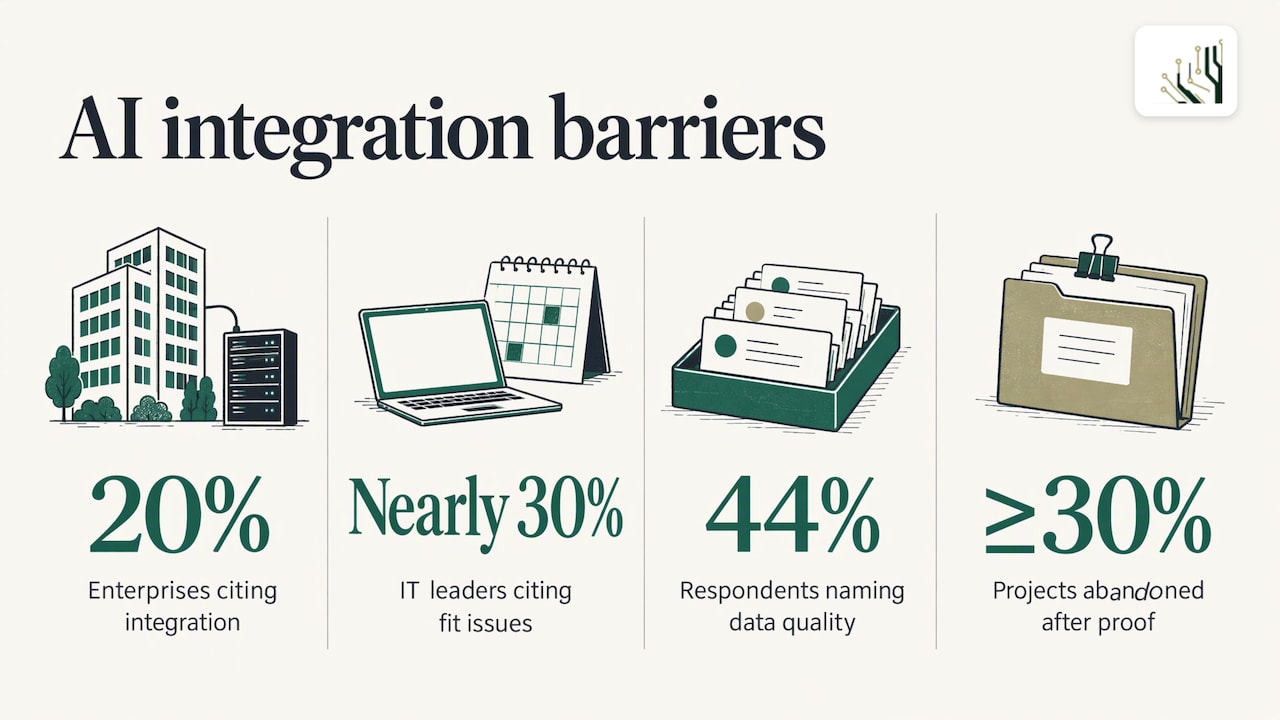
Teams are often surprised that the AI itself is the easy step. Gartner, as reported by Kong in May 2026, found that integration ranks among the top three barriers to AI implementation for 20% of enterprises, and that nearly 30% of IT leaders deploying generative AI assistants cited trouble fitting them into daily work. The stated reason: enterprise applications were not designed to be used by AI agents.
Data is the other trap. BARC’s 2025 survey found 44% of respondents named data quality as the top obstacle to AI project success, up from 19% in its 2024 results. Gartner also forecast, per Computerworld’s 2024 report, that at least 30% of generative AI projects would be abandoned after proof of concept through 2025, citing poor data quality, risk controls, rising costs and unclear value.
Two practical lessons follow. First, check your data before you commit to a build; our guide on how to tell if your data is ready for AI walks through it. Second, treat the connection layer as real engineering, not glue.
What a solid engagement includes
1. Workflow mapping and feasibility
Planning should start by mapping how work is done today: where decisions are made and which systems support them (ERP, CRM, data warehouses, legacy apps). Then comes feasibility: data availability and access, API options, latency, scalability, security and privacy limits, and infrastructure readiness.
This is where a team that spans product and engineering earns its keep. A product lead decides which workflow is worth automating; an engineer knows whether the system can support it. When they sit in separate firms, the finding gets lost in a handoff.
2. Requirements you define before building
Decide these early, because they shape cost and design:
- Real-time or batch processing.
- Expected volume and throughput.
- Output format the downstream system needs.
- Reliability and what happens when the AI fails (fallback).
- How personal data is handled.
- How decisions are explained.
- How feedback is collected to improve the model.
3. Interfaces and control
For AI agents that take actions, Gartner’s framework, as summarized by Kong, has three parts: machine-readable, standardized APIs; a control layer that handles routing, authentication, authorization, rate limiting and logging; and clean, governed, well-labeled data. Gartner advises using the Model Context Protocol initially only to read contextual data, not to update production applications directly.
If your AI feature depends on connecting several tools, see our overview of API integration services and how to buy them.
4. Design and user trust
An AI feature that people ignore delivers nothing. Interface design decides whether users see the suggestion, understand it and can override it. Usability testing before launch is cheaper than rebuilding afterward.
5. Governance and monitoring
Integration commonly ends with monitoring performance under governance and human oversight. In AvePoint’s 2026 report, based on an Osterman Research survey of 750 respondents, 54.8% of organizations added human-in-the-loop controls to address security concerns, and 51.6% provided employee training.
How to scope your first AI integration
A workable path, drawn from SAP’s guidance on readiness:
- Pick one repeatable, high-value workflow. Frequent, measurable and owned by a clear team.
- Map its systems, data and users. Include who touches it and where decisions occur.
- Assess data readiness and integration gaps. Fix the data issues that would sink the pilot.
- Choose the method. API, RAG, workflow tool or built-in capability, depending on your landscape and goals.
- Run a controlled pilot. Small user group, defined metrics.
- Set governance, then scale. Ownership, logging, human review rules.
Speed matters here. A pilot that reaches real users in weeks teaches you more than a long roadmap. Our approach is built around shipping an actual release in about two weeks, then expanding what works.
What drives cost and timeline
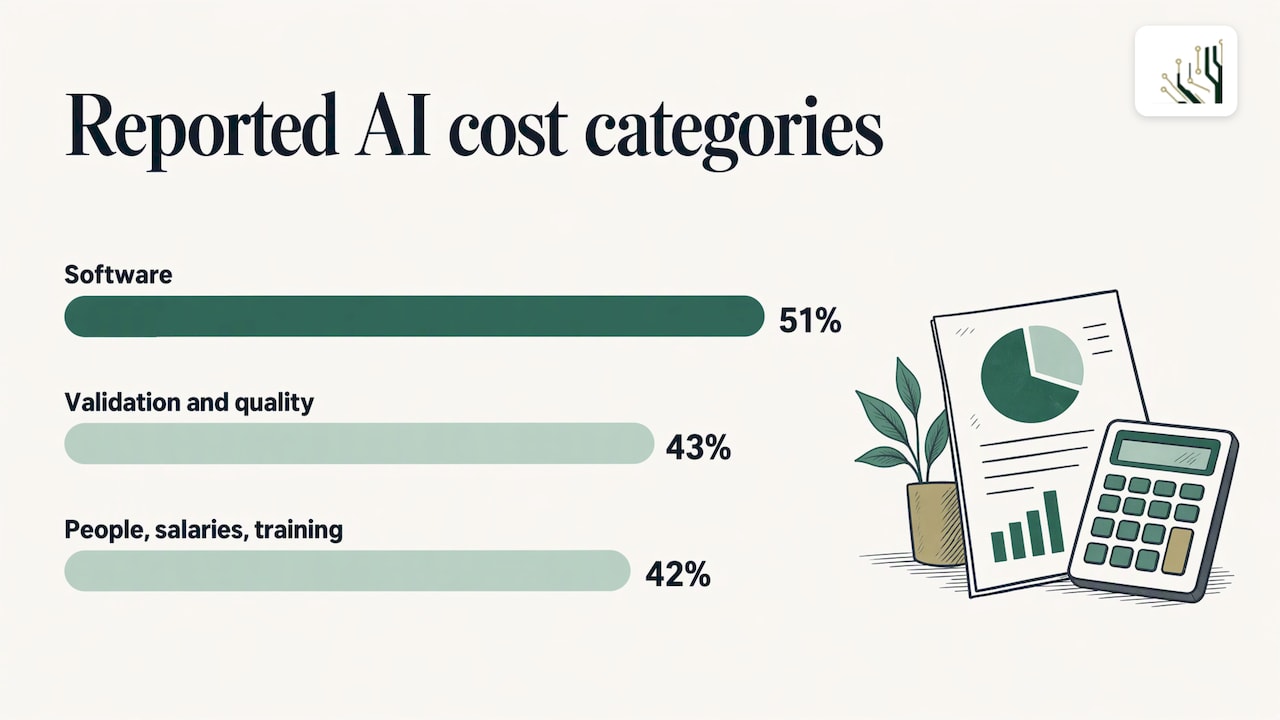
Published prices for this work vary widely and depend on scope, so be wary of any flat number without a defined workflow behind it. BARC’s 2025 report shows where organizations feel the cost: software (51%), validation and quality control (43%), and people, salaries or training (42%). Notice that validation and people rival software. Budget for testing and for enabling your team, not only for the build.
Timeline follows three things: how clean your data is, how many systems the feature touches, and how much review the output needs before it reaches a customer.
How to choose an AI integration partner
CIO’s reporting on implementation partners says a good one understands your industry, regulatory and data-governance requirements, and operational workflows. It also recommends involving technology, security, executive, legal and HR stakeholders in due diligence, and examining a partner’s security, privacy and ethical record.
Turn that into questions for any provider:
- Who does the work, and how senior are they?
- Will the same people handle strategy, build and measurement?
- How is the first release scoped, and when does it ship?
- How will my team run this after the engagement ends?
- How will the feature avoid disrupting critical processes?
The last one is a CIO theme: embed AI without disrupting critical workflows.
Where Inner Roots fits
Inner Roots is a consulting studio that combines product management, engineering, UI design, UX research, data analytics and AI and machine learning under one roof, led by senior people. Because those disciplines work together, an AI idea moves from discovery to a shipped release without being re-explained to a new team. Our approach is honest scoping and enablement that outlasts the engagement, so your staff can keep improving what we build.

If you have a workflow in mind, explore our AI, data and product services or see how we worked with brands like Venroy and Weedmaps. Building AI into a SaaS product specifically? Our guide to SaaS product development covers the process.
FAQ
What are AI integration services?
They are consulting and engineering work that connects AI models to your existing software, data and workflows. That typically includes use-case selection, data preparation, building the connections, testing, rollout and monitoring.
What is the difference between AI integration and AI development?
Development builds or trains a model. Integration puts a model, whether built or bought, into your product or operations so it works on your real data. Most companies need integration far more than custom model training.
How long does an AI integration take?
It depends on data quality, the number of systems involved and the review the output needs. A tightly scoped pilot on one workflow can reach users quickly; our own engagements typically deliver a first release within two weeks.
What should we prepare before starting?
Name one workflow, list the systems and data it touches, and check data quality and access. Decide who owns the feature and who reviews its output. Those four items shorten almost every project.
Does AI integration require sending sensitive data to a model?
Not necessarily. Requirements for personal data handling, access control and human review are set during scoping, and anonymizing data before use is a common safeguard, as in the dialysis example above. Involve your security and legal stakeholders early.
Sources
- What Is AI Integration: Building Digital Enterprises, SAP
- What to look for in an AI implementation partner, CIO
- Gartner: AI Agent Integration Requires an AI Control Layer, Kong
- PMI-CPMAI: Integrating AI with Existing Systems and Workflows
- BARC Research Survey: Lessons From the Leading Edge
- Biggest problems and best practices for generative AI rollouts, Computerworld
- Scaling Trust, Control, and Readiness in the Agentic Era, AvePoint
- AI Singapore: 100 Experiments, Compendium of Use Cases, IMDA