AI MVP Development: A Founder’s Guide to Shipping Fast
An AI MVP is the smallest working product that gives its first customer real value on day one and beats what they do today. It does not have to beat the best model in the world. The founders who get there fastest treat it as one product problem, not a research project. Product strategy, engineering, design and data decisions are made together, so nothing is lost between handoffs. That is how we run engagements at Inner Roots Tech Solutions, with first releases typically within two weeks.
This guide covers what an AI MVP is, how to scope it, how to pick the technical approach, how to measure it and how to turn the results into a roadmap.
TL;DR
- An AI MVP must solve one specific problem, deliver value on day one and beat the current baseline, not the state of the art.
- Add AI only where it solves the problem in a way rules cannot. Otherwise ship the simpler version first.
- Write the scope as one sentence: one user, one job, one moment of value, plus a pass threshold set before you collect evidence.
- Start with the simplest technique that proves the business value: prompting first, then retrieval, then fine-tuning if needed.
- Plan the roadmap as a sequence of experiments with kill or pivot points, and let MVP results reorder it.
Table of Contents
- What an AI MVP is, and what it is not
- Decide whether v1 needs AI at all
- Scope the smallest useful version
- Choose the technical approach
- Build in stages, not in one long push
- Measure what matters before you scale
- Build the AI product roadmap from experiments
- Where we fit
- FAQ
- Sources
What an AI MVP is, and what it is not
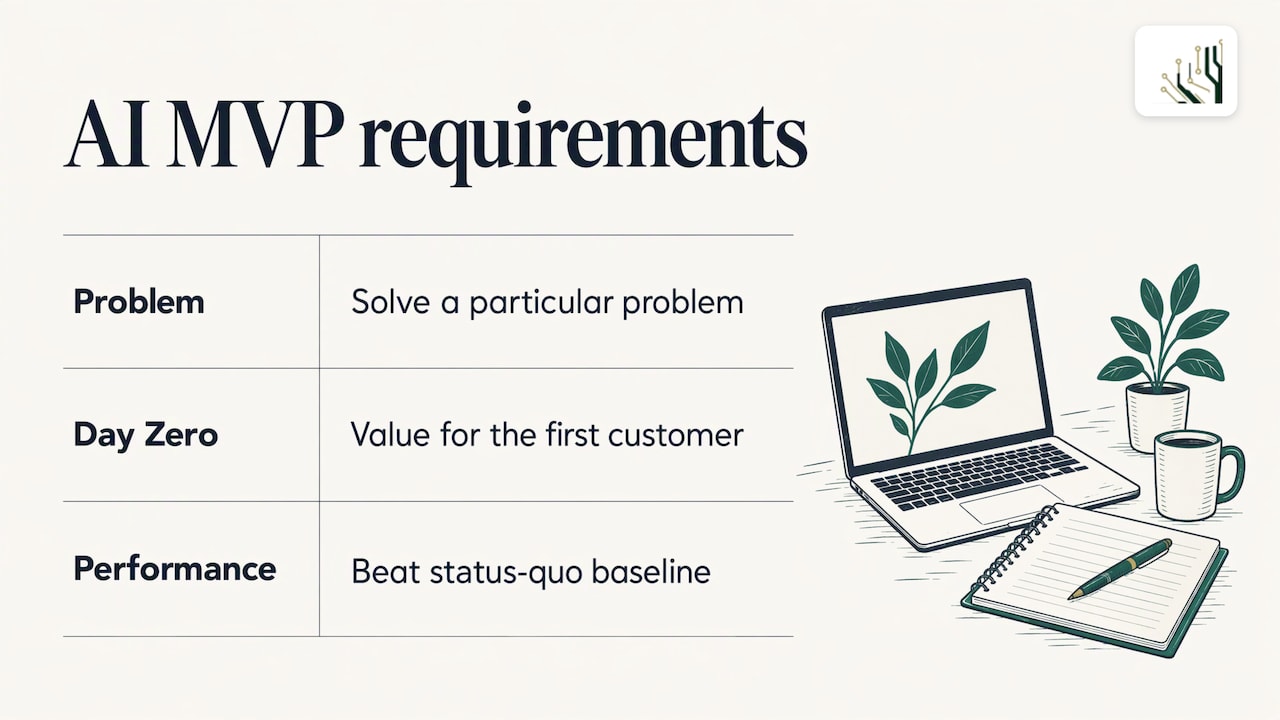
A classic MVP tests whether anyone wants your idea. An AI MVP adds a second question: can the technology do the job well enough? MIT Sloan Management Review’s definition is useful here. An AI MVP has to solve a particular problem, provide “Day Zero” value to the first customer and reach minimum viable performance, meaning it beats the status-quo baseline rather than the world.
That baseline might be a spreadsheet, an intern, a manual review queue or a keyword search. If your model is right 80% of the time, that can be valuable for some tasks and useless for others. The same article notes that 80% is entirely inadequate for something like speech recognition. So the bar depends on what the user does today and what a wrong answer costs them.
Day Zero value also explains why many AI MVPs are not fully automated. The same MIT piece describes ways to deliver value before you have a perfect model: cleaning the first customer’s data, training on public datasets, routing low-confidence answers to a human, or using rules-based technology for part of the flow. O’Reilly’s description is similar: the MVP should be robust enough for user research and model evaluation, yet simple enough to be quickly discarded or adjusted, while still viable enough that users want it.
Decide whether v1 needs AI at all
The most expensive mistake in this category is starting with “we need AI” instead of “we need to solve this problem.” Google’s People + AI Guidebook says a rule or heuristic often works as well as an AI version and is easier to build, explain, debug and maintain. Its advice is to swap “Can we use AI to do X?” for “How might we solve X?” and add AI only when it solves the problem in a unique way.
The same guidebook lists where AI tends to earn its place and where it does not.
| AI is usually a strong fit | AI is usually a weak fit |
|---|---|
| Recommending different content to different users | Interfaces that must stay predictable, like a Cancel button |
| Predicting future events | Static or very limited information |
| Personalization | Situations where errors are very costly |
| Understanding natural language | Cases needing complete transparency |
| Recognizing a class of entities | Optimizing purely for speed or cost |
| Detecting rare, evolving events such as fraud | Tasks users say they do not want automated |
PAIR also separates automation from augmentation. Automate tasks that are difficult, unpleasant or need scale, where people agree on what “correct” means. Augment tasks people enjoy, that carry social status, or where people disagree on correctness. For an MVP, augmentation is often the faster route because a person stays in the loop to catch mistakes while you learn how the model fails.
If your answer is that part of v1 should be rules and part should be a model, that is a good answer. It is also a design decision, which is why product and engineering need to be in the same room early.
One practical note: if your product depends on language data, labeling or annotation work, the people who build that capability are a specialist hire. Hiring in language data and annotation has its own talent market, so plan for it before you commit to a fine-tuning-heavy approach.
Scope the smallest useful version
An AI MVP balloons when it tries to serve several user types with several jobs. The fix is to write the scope as a single sentence that names a person, a behavior that costs them something and the thing you put in front of them. One published example: independent bookkeepers with ten to forty clients will upload a month of receipts and return the next month to do it again, when the tool turns those receipts into categorized entries in under five minutes. That scope comes from a founder-focused guide to building an MVP with AI, along with the rule to keep one user type, one job end to end and one moment of value.
Write these four things down before anyone writes code:
- The user. A specific role, not “small businesses.”
- The job. One task, done start to finish.
- The moment of value. What the user sees that makes them come back.
- The threshold and the date. What result counts as a pass, and when you will look.
The threshold matters most. Set it before you collect evidence, or you will talk yourself into whatever the data says.
Test demand before you build
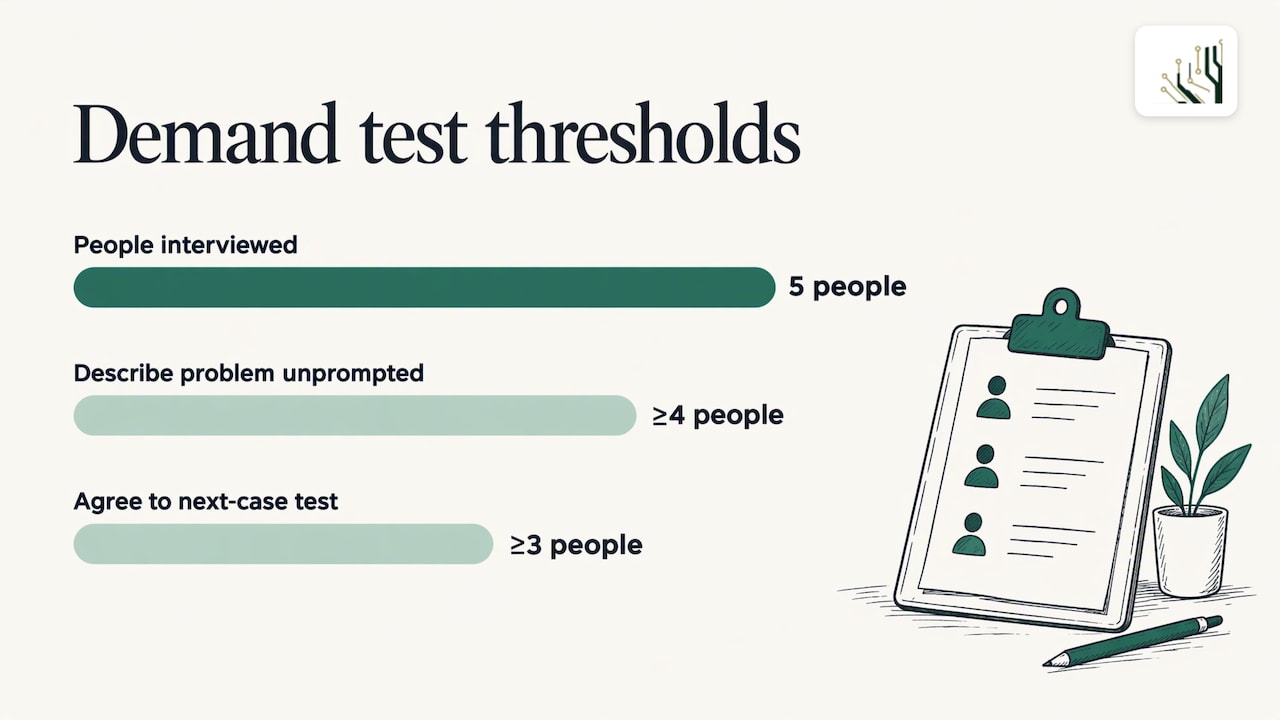
The cheapest demand test is a handful of problem interviews. Talk to five people who did the job recently, ask for real examples rather than opinions, and then ask whether they would hand you their next real case. A workable pass mark, from one published validation guide, is at least four of five describing the problem without being led and at least three agreeing to a next-case test. Treat the numbers as a starting rule, not a law.
Anthropic’s founder playbook frames the end goal of the MVP stage the same way: the smallest working product in front of real users, judged by whether an identifiable group returns, pays or refers others. Those three signals, retention, revenue and referral, are the exit criteria worth writing into your plan.
Test feasibility by doing the job by hand
For AI products where a model does a judgment-heavy task, feasibility is often the biggest unknown. A cheap check is to do the task yourself for the first few customers using today’s AI tools and watch where the output fails. You learn the real error rate before you promise automation, and you often discover the first version should be assisted rather than automated.
Choose the technical approach
Founders often jump to training a custom model. Almost nobody needs that for a first release. AWS’s guidance on generative AI proofs of concept recommends starting with the simplest method that validates core business value. Its progression is:
- Prompt engineering first. Fast, cheap to change and enough for many MVPs.
- Retrieval-augmented generation (RAG) when answers must be grounded in your own or up-to-date documents. RAG means the system looks up relevant text and gives it to the model before it answers.
- Agentic approaches for complex, multi-step tasks that use tools.
- Fine-tuning for style, format, niche terminology or a narrow repetitive task that prompting and RAG cannot handle.
The source for that ladder is AWS prescriptive guidance on architecting a generative AI proof of concept. Each rung adds cost, data requirements and things that can break, so you climb only when the rung below has failed on a measured test.
Data is usually the schedule risk
The model choice is rarely what delays an AI MVP. Data is. Customer records are inconsistent, documents are scattered, permissions are unclear. Before you commit to a build plan, check what you have, where it lives and whether it is clean enough to use. Our guide on AI data readiness walks through that check, and our overview of AI integration services explains how a model gets wired into the product and systems around it.
Build in stages, not in one long push
Teams that ship AI products on time tend to separate the work into stages with an exit test at each one:
- Discovery and data audit. Confirm the problem, the user, the data and the baseline you must beat.
- Prototype. A rough working version that real users can react to.
- MVP build. The one job, end to end, with the interface, integrations and logging in place.
- Evaluation and hardening. Test against a fixed set of cases, fix failure modes, add guardrails.
- Launch and iteration. Release to a small group and learn.
Do not expect a fixed date for a model you have not tested. The AI PM Playbook from Golden Source Training argues that AI work cannot promise feasibility, quality or cost until it meets real data, so discovery and data work should be time-boxed with exit criteria and data cleanup carried as explicit contingency. We agree with the spirit of that: honest scoping beats an optimistic Gantt chart.
The design side is not an afterthought either. A model that is 90% accurate still fails if users cannot tell when to trust it, how to correct it or how to undo an action. This is where UX research and usability testing pay off early. Our guide to usability testing covers how to run it on a prototype.
Measure what matters before you scale
AI MVPs need two kinds of measurement: product value and model behavior.
Product value. O’Reilly’s framework for AI product managers has experiments in three phases. At the concept stage, ask whether the AI can move an upstream business metric. Before deployment, set guardrail metrics so the model cannot game its target. After deployment, keep monitoring, because performance can degrade as the environment changes.
Model behavior. Microsoft Research’s framework for evaluating language model features suggests tracking token utilization, time to first token at several percentiles, an accept or reject funnel for responses, edit distance, thumbs up and down, and retention to spot novelty effects. It also recommends dark-mode and small-scale experiments at launch, then shadow and wider experiments afterward.
For a first release, a short list is enough:
- Task completion without help
- How often users accept, edit or reject the AI output
- Return usage in the following week
- Time saved versus the baseline
- A count of serious failures, with a threshold that triggers a pause
Build a fixed test set of representative, edge and previously failed cases before the feature, and rerun it after every change. That turns “it feels better” into a number.
Build the AI product roadmap from experiments
A roadmap for an AI product is a sequence of bets, each with evidence attached. Three habits keep it honest.
Write the kill or pivot point in advance. Decide what result stops the work or changes direction, and agree on it with whoever funds the project before results arrive.
Sequence by evidence, not enthusiasm. Group work as Now, Next and Later. Only items backed by a real test result against a pre-agreed metric move into a full build. Items resting on a hunch stay in a learning phase.
Experiment fast so you do not break things later. O’Reilly’s authors contrast this with “move fast and break things,” because changes to a model or its data can quickly affect revenue. Fast prototyping and the ability to pull an underperforming model are the point.
A workable first quarter has one learning sprint, one larger bet and a shorter follow-up. After that, MVP results should reorder the list. If users keep editing the same kind of output, that is your next improvement. If they ignore a feature you thought was central, it moves down. If a segment you did not plan for returns weekly, that is a signal worth a discovery sprint. For turning raw comments into themes you can act on, see our guide to customer feedback analysis.
Where we fit
An AI MVP touches product strategy, engineering, UX, data and often the website or platform around it. When those sit with separate vendors, the problem statement gets diluted at each handoff. At Inner Roots, a senior-led team covers product management, UX research, UI design, data analytics, AI and machine learning, and website creation under one roof, and we aim to ship actual releases within two weeks. Our scoping is honest by design, and our enablement is meant to outlast the engagement.
If you have a problem statement and want a scoped first release, start with our services.

If you want to see how we work with product teams, our Venroy case study is a good place to look. When the AI feature has to live inside a larger product, our guide to SaaS product development covers the wider process.
FAQ
How long does an AI MVP take?
It depends on scope, data and integrations. A simple assistant is a much smaller job than a retrieval-based app or an agent that touches payments or customer records. Data readiness is usually the biggest schedule risk. Our first releases typically ship within two weeks, and we scope the rest after discovery.
Do I need to train my own model?
Usually not for a first release. Start with prompting, add retrieval when answers must draw on your documents, and consider fine-tuning only for a narrow, repetitive task the first two cannot handle. AWS’s guidance recommends the simplest method that proves the business value.
How do I know my MVP is working?
Define the pass threshold before launch. Look for users who complete the job unaided, return the next week, accept the AI’s output without heavy edits and, ideally, pay. Anthropic’s playbook names retention, revenue and referral as the evidence of fit.
Should every MVP include AI?
No. If a rule solves the problem as well, ship the rule and add AI where it solves something rules cannot. Google’s PAIR guidance recommends asking how to solve the problem before asking how to use AI.
Sources
- What Is a Minimum Viable AI Product? (MIT Sloan Management Review)
- People + AI Guidebook: User Needs and Defining Success (Google PAIR)
- People + AI Guidebook: All Chapters (Google PAIR)
- Bringing an AI Product to Market (O’Reilly)
- How to Build an MVP With AI: What to Build, What to Skip
- How to Validate Demand for an AI Feature Before Building It
- The founder’s playbook: MVP stage (Anthropic)
- Architecting a successful generative AI proof of concept (AWS)
- How to Evaluate LLMs: A Complete Metric Framework (Microsoft Research)