
Cloud Architecture Consulting: What It Covers and When to Hire It
Cloud architecture consulting is paid expert help in deciding how your product, data and infrastructure will run in the cloud, and then getting that design into production. The best engagements do not stop at a diagram. The people who design the architecture also help build, measure and adjust it, so decisions are not lost between a strategy deck and the engineers who have to live with it. That integrated approach is how we work at Inner Roots Tech Solutions: product strategy, engineering, design and data under one roof, with first releases typically landing within two weeks.
TL;DR
- Cloud architecture is the design of how cloud services fit together to run your application. A consultant turns your business needs into platform choices, a deployment plan and guardrails.
- The costly mistakes come from architecture by accumulation: scattered accounts, unclear spending, security gaps and lock-in that nobody chose on purpose.
- Judge any design against six pillars: operational excellence, security, reliability, performance efficiency, cost optimization and sustainability.
- Price depends on scope, not a standard rate card. Workload count, legacy complexity and compliance needs move it most.
- For founders, the best fit is a senior team that designs and builds together, so the architecture ships with the product.
Table of Contents
- What cloud architecture actually is
- The problem consultants are hired to prevent
- What a cloud architecture consultant does
- When you need it
- How to evaluate an architecture: six pillars
- How an engagement runs
- Where speed and integration come in
- What it costs
- Work with a team that designs and ships
- Questions to settle before you sign anything
- FAQ
- Sources
What cloud architecture actually is
Start with the basics. The U.S. National Institute of Standards and Technology (NIST), the federal standards body, defines cloud computing as on-demand network access to a shared pool of configurable resources that can be provisioned and released quickly with minimal management effort. In plain terms: you rent computing, storage and networking instead of buying servers, and you can scale up or down.
Cloud architecture is the layer above that. Microsoft describes it as the design and structure of how cloud services are delivered, including the components that work together to run applications over the internet. It answers practical questions. Where does your data live? How does traffic reach your app? What happens when one component fails? Who can touch production? How do you see what you are spending?
The same Microsoft page notes that good cloud architecture can help an organization scale, improve performance and cost efficiency, and keep security and reliability in check, and that cloud resources are typically billed pay-as-you-go. That last point matters for founders: pay-as-you-go is a benefit when the design is deliberate and a surprise invoice when it is not.
The problem consultants are hired to prevent
Most teams do not choose a bad architecture. They drift into one. A prototype goes live on one account, a second service gets added for a deadline, a contractor sets up another environment, and a year later nobody can draw the whole system.
TechTarget has reported that cloud adoption by accretion can produce fragmented accounts, poor visibility into spending and interdependencies, security oversights and vendor lock-in when architectural choices are made without deliberate governance. Those are the four symptoms a founder usually describes in other words: “our bill jumped and we don’t know why,” “we can’t change vendors,” “one engineer holds all the access,” “every release feels risky.”
An architecture engagement replaces drift with decisions you can explain to a new hire, an investor or an auditor.
What a cloud architecture consultant does
TechTarget’s overview of cloud consulting says consultants investigate an organization’s needs and translate them into a cloud strategy and a tactical deployment plan, including guidance on architecture and platform choices. In practice the work usually breaks into a few deliverables:
- Requirements and workload mapping. What the product must do, how many users, how much data, which latency, uptime and compliance obligations apply.
- Platform and service selection. Which provider, which managed services, and whether anything justifies a more complex setup.
- Target architecture. The agreed design: networks, environments, data stores, identity and access, monitoring.
- Migration or build plan. The order of work, with dependencies and risks called out.
- Governance and cost visibility. Account structure, tagging, budgets and alerts so spending is readable.
- Handover. Documentation and enablement so your team can run what was built.
The terms “consulting,” “consultant” and “services” are used loosely online. A consultant is the person; services are the packaged work. What you should care about is whether the same people who draw the design stay close enough to the build to correct it when reality pushes back.
When you need it
You do not need an architect to host a landing page. You do need one when a few conditions appear:
- You are about to build or rebuild a product that will carry real customer data or revenue, and the first design will be hard to undo.
- You have grown by accretion: multiple accounts, no clear owner, rising costs, and slow releases.
- You are adding AI or data workloads that change how much compute and storage you need and where sensitive data flows. Our guide to AI integration services covers that side.
- You are modernizing an older system and need to choose between rehosting, refactoring and rebuilding. See our walkthrough of legacy system modernization.
- Customers or partners are asking about security, compliance or uptime and you need answers that hold up.
For an early-stage founder the outcome to expect is not a perfect platform. It is a foundation that lets you ship now without painting yourself into a corner later. If you are building software as a product, our SaaS product development guide shows where architecture fits in the larger process.
How to evaluate an architecture: six pillars
A design is easier to judge against a shared yardstick. AWS’s Well-Architected Framework evaluates architecture across six pillars: operational excellence, security, reliability, performance efficiency, cost optimization and sustainability. The Cloud Security Alliance’s 2025 security guidance names the same six and stresses tailoring practices to your organization’s context and risk. The pillars are useful as questions, whichever provider you use:
| Pillar | Question to ask of the design |
|---|---|
| Operational excellence | Can we deploy, monitor and recover without heroics? |
| Security | Who has access to what, and how do we know? |
| Reliability | What breaks when one part fails, and how fast do we recover? |
| Performance efficiency | Does capacity match demand as we grow? |
| Cost optimization | Can we explain every line of the bill? |
| Sustainability | Are we using resources no larger than the work needs? |
The same CSA guidance describes infrastructure as code, meaning infrastructure defined in version-controlled files instead of clicked together by hand, as enabling consistent, reviewable provisioning and automated security checks. For a small team this is one of the highest-leverage habits: environments become repeatable, and changes leave a trail.
Choosing a platform and avoiding needless complexity
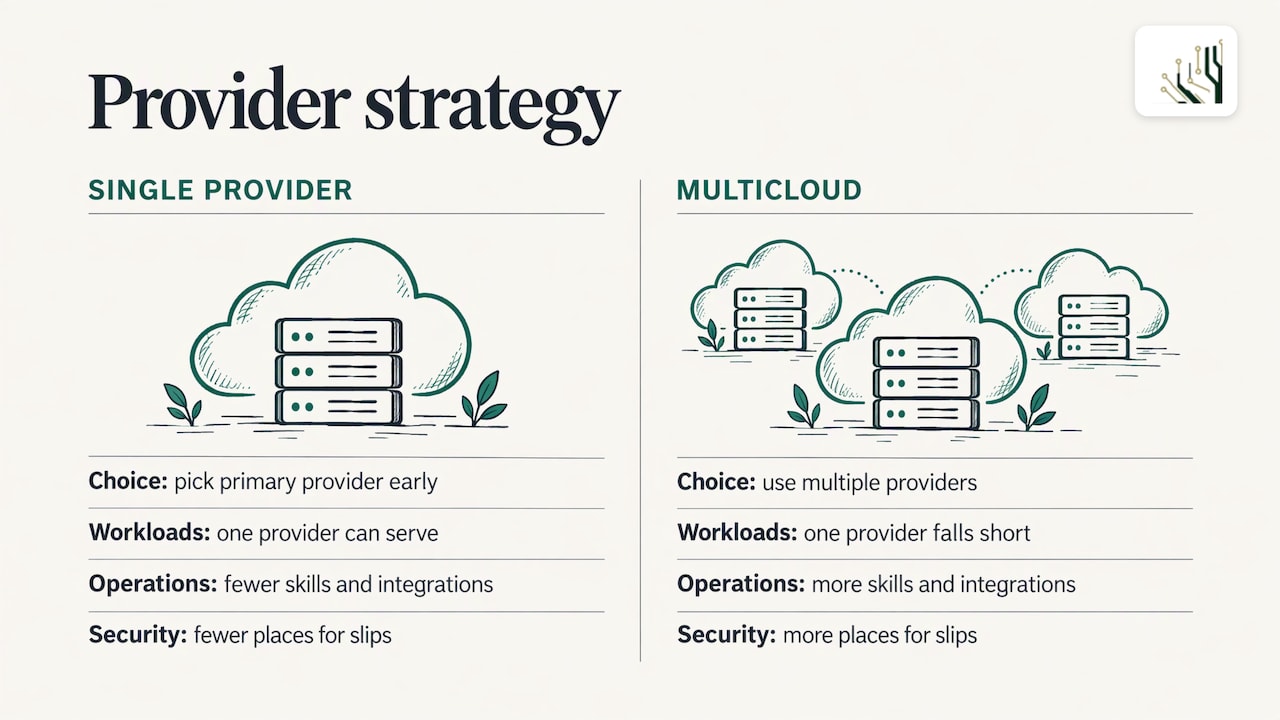
The research on platform choice is consistent. NIST’s cloud computing synopsis says organizations should select cloud technologies and configurations according to their own requirements, because service models, deployment models and configurations vary widely. AWS’s prescriptive guidance lists what to weigh: workload and business requirements, breadth of provider services, security and compliance, data transfer costs and latency, partner network, support and training, and whether hybrid or multicloud complexity is justified.
That guidance was written for education customers, but the logic carries over. It recommends choosing a primary strategic provider early in adoption and reserving multicloud for workloads one provider cannot serve. For a startup, that usually means one provider, a clean account structure and a short list of managed services your team can actually operate. More clouds mean more skills, more integrations and more places for security to slip.
How an engagement runs
The shape below is typical for a scoped architecture project, whoever delivers it.
1. Discovery
The team maps what exists and what the business needs: applications, data, users, integrations, compliance duties and budget. TechTarget’s migration guidance warns that planning must account for application and data dependencies, security, integrations, configuration and workload destination, and that without it even a single-cloud migration can be complex and fail in several ways. Discovery is where those dependencies surface on paper rather than in production.
2. Target design and roadmap
You get a proposed architecture, the trade-offs behind each choice, and a sequenced plan. A good roadmap names what ships first. Integration points matter here, since most products connect to payment, CRM or data systems; our guide to API integration services explains what that work involves.
3. Build and migration
Workloads move or get built in the agreed order. TechTarget’s cloud consulting overview describes consultants helping identify which workloads suit migration and moving assets while minimizing disruption to ongoing operations. Small, reversible steps beat a single cutover weekend.
4. Instrumentation and handover
Dashboards for cost, uptime and usage go live with the system, and your team gets the documentation and training to own it. An architecture nobody on your side understands is a dependency, not an asset.
Where speed and integration come in
Founders rarely buy architecture for its own sake. They want a product in customers’ hands. The usual friction is the handoff: strategy in one document, design in another, infrastructure in a third, each owned by a different vendor, with intent lost at every transfer.
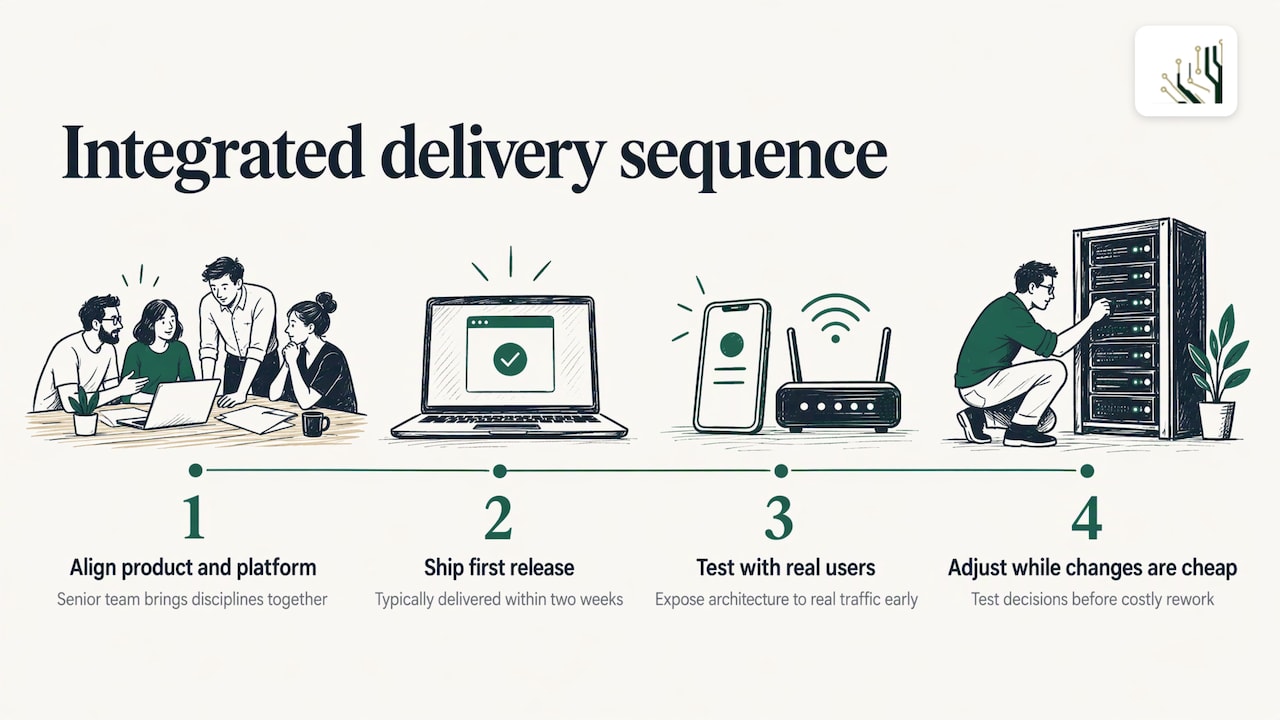
That is the gap our studio is built to close. Our senior-led team brings product, engineering, design and data capabilities together, and our projects typically deliver a first release within two weeks. When the person scoping the product is in the same conversation as the person choosing the platform, a requirement like “customers must see their data in real time” becomes a design decision on day one instead of a rework in month four.
There is also a practical sequencing benefit. A first release forces the architecture to meet real traffic and real users early, so decisions are tested while they are still cheap to change.
What it costs
There is no standard tariff for cloud architecture work, and any single number you find online reflects a particular country, seniority level and scope. What reliably moves the price:
- Number of workloads to design or migrate.
- Legacy complexity: older systems with undocumented dependencies take longer.
- Compliance requirements such as healthcare, payments or regulated industries.
- Seniority of the people doing the work.
- Engagement model: a fixed-scope project, a review, or ongoing support.
- Geography of the team.
The cleanest way to control cost is a tightly scoped first phase with a defined output, then extend only if it is working. We scope honestly and do not publish a fixed price for architecture-related work, because the right figure depends on the factors above.
Work with a team that designs and ships
If you are a founder or business leader who needs a technical foundation that moves quickly, our services cover product management, website and platform creation, data analytics, AI and machine learning, UI design and UX research under one engagement. Teams at brands such as Curaleaf and Venroy have worked with us; you can read how the Venroy project came together.

To talk through your product and what architecture it needs, start from our main site and book a conversation.
Questions to settle before you sign anything
Whoever you choose, get clear answers to these:
- Who exactly will do the work, and how senior are they?
- Will the designers of the architecture also be involved in building it?
- What will exist at the end of week two, and what at the end of the engagement?
- How will you handle security, access and cost visibility from the first environment?
- What documentation and enablement will your team receive so it can run the system?
An engagement that answers these in specifics, with a scoped first phase, is usually one that will deliver.
FAQ
What is the difference between a cloud architecture consultant and a cloud engineer?
A consultant designs the approach: platform choices, structure, security model and plan. An engineer builds and operates it day to day. On small teams one group often does both, which keeps the design and the build aligned.
Do startups really need cloud architecture consulting?
Not for a simple site, but yes when you are building a product that will hold customer data or scale quickly. A short engagement early prevents the scattered accounts, unclear spending and lock-in that come from unplanned growth.
Should we use more than one cloud provider?
Usually not at the start. AWS’s own guidance recommends a primary provider and reserving multicloud for workloads that one provider cannot support. Fewer providers means fewer skills to maintain and fewer security gaps.
How long does it take to see results?
That depends on scope, but our projects typically ship a first release within two weeks. A full migration or redesign of a larger system takes longer and is best planned in phases.
Sources
- NIST Cloud Computing Standards Roadmap
- NIST Special Publication 800-146, Cloud Computing Synopsis
- What Is Cloud Architecture? | Microsoft Azure
- Application architecture changes force IT to adjust focus | TechTarget
- What is cloud consulting? Everything you should know | TechTarget
- Set your AWS cloud migration strategy before the big move | TechTarget
- AWS Well-Architected Framework definitions
- AWS Prescriptive Guidance: Building a strategy for single, hybrid and multicloud
- Cloud Security Alliance Security Guidance, 2025